Understanding CNC Milling
Milling is a subtractive manufacturing process that utilizes rotating multi-point cutting tools to remove material from a workpiece. The workpiece is secured to a table, while the spindle, holding the tool, maneuvers through space according to programmed coordinates.
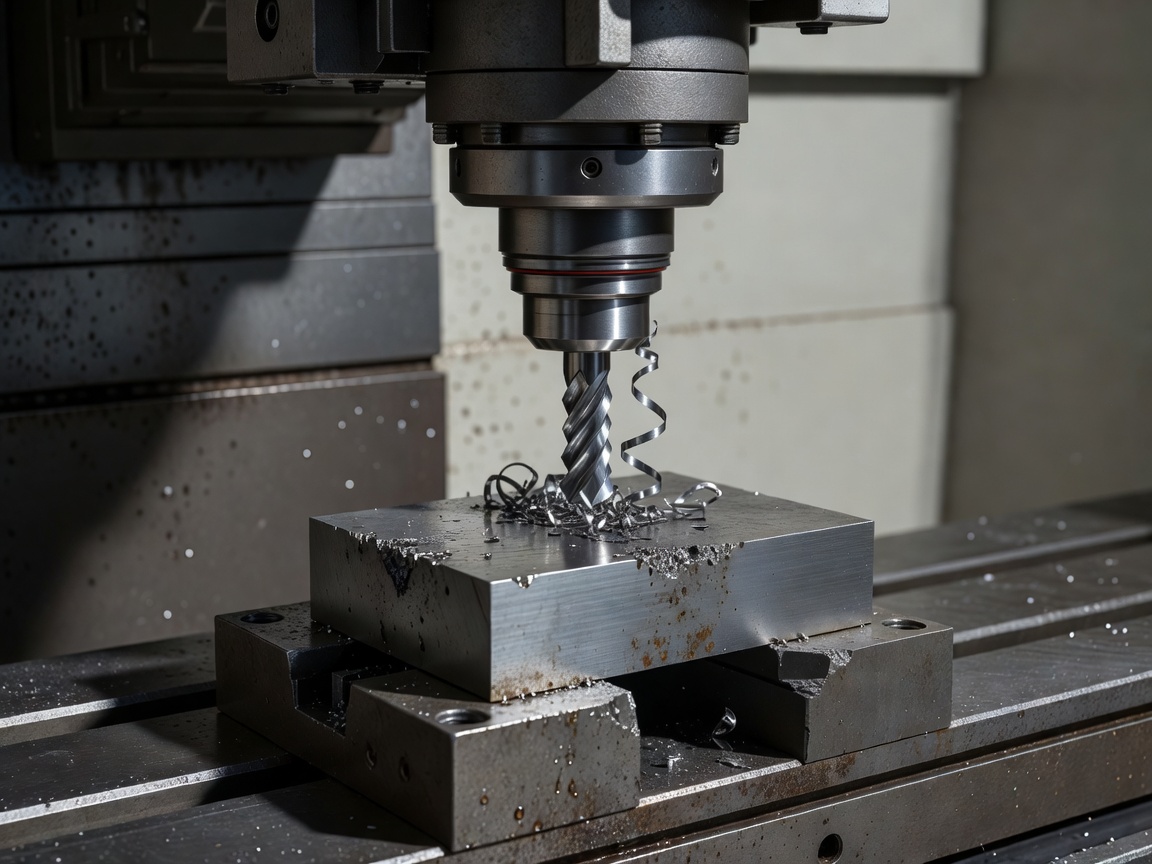
Vertical vs Horizontal Machining Centers
Machining centers are generally categorized by the orientation of their main spindle.
- Vertical Machining Centers (VMC): The spindle axis is vertically oriented. Best for die sinking, flat parts, and operations requiring deep reach into open cavities.
- Horizontal Machining Centers (HMC): The spindle is horizontally oriented. Ideal for heavy material removal, as gravity assists in clearing chips away from the cutting zone. Often equipped with tombstone fixtures for multi-part setups.
Understanding 5-Axis Machining
While 3-axis machines move along X, Y, and Z linear axes, 5-axis machines add two rotary axes (A, B, or C depending on configuration). This allows the tool to approach the workpiece from almost any angle.
Positional (3+2) vs. Continuous 5-Axis
3+2 Machining: The rotary axes reposition the workpiece to a specific angle, lock into place, and standard 3-axis milling is performed. It reduces setups but does not move all 5 axes simultaneously.
Continuous 5-Axis: All five axes interpolate simultaneously during the cut. This is essential for complex surfacing, such as turbine impellers or highly contoured aerospace components, keeping the tool perfectly normal to the surface at all times.
High-Speed Machining (HSM) Strategies
Modern CAM software generates toolpaths utilizing High-Speed Machining principles. By maintaining a constant tool engagement angle and utilizing trochoidal motion, machinists can run tools at significantly higher feed rates without overloading the cutter. This reduces heat transfer into the part and extends tool life.